


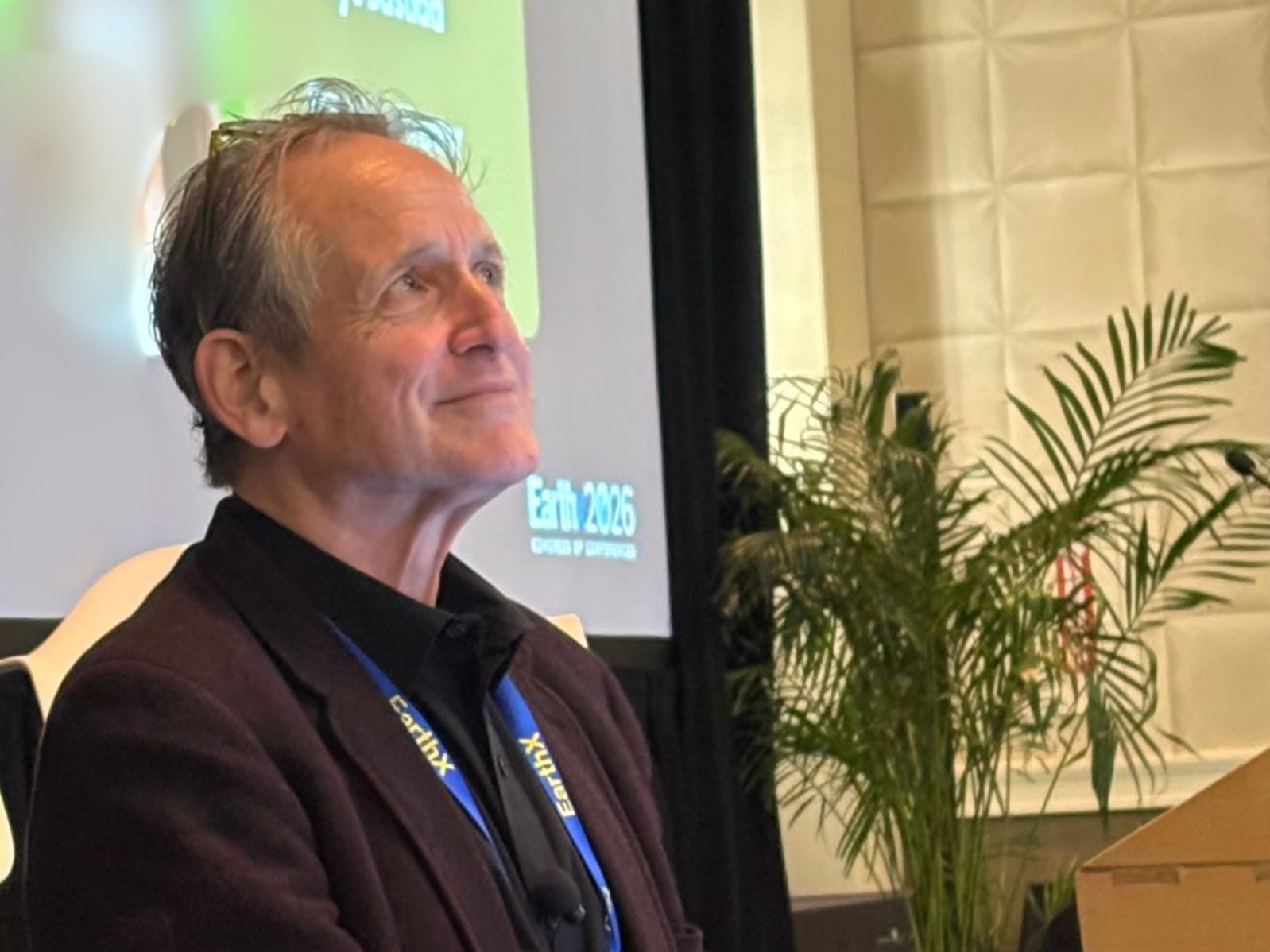
Just one month ago on Earth Day, we launched Circle America at Earthx2026 in Dallas. I felt deeply gratified — and honestly humbled — standing on the stage at Earthx2026 announcing the launch of Circle America.
About 120 leaders joined us that day: scientists, business leaders, activists, innovators, investors, ranchers, technologists, environmentalists, and bridge-builders from across America’s political and cultural divides.
As I looked around the room, I felt something I haven’t felt in quite this way before. Not triumph. Not certainty. Something softer. Gratitude, maybe. And relief.
Because recently I’ve been thinking a lot about lines and circles. Recently, in this case, means about fifty years!
But I’ve been thinking about them even more lately. At our launch, I began by saying, “The line has had a good run.”
And it has.
The linear economy — materialistic, mechanistic, hyper-rational — powered the Industrial Revolution. It unleashed astonishing productivity and abundance. It transformed human life and helped wipe out material scarcity for billions of people.
Extract. Manufacture. Consume. Discard.
The line produced extraordinary progress. But, increasingly, it also feels like we are reaching the end of that line.
We see it in climate disruption, collapsing coral reefs, disappearing rainforests, mass extinction, oceans filling with plastic, and weapons and viruses and toxic wastes and toxic leaders powerful enough to erase civilization.
We see it in artificial intelligence racing ahead faster than wisdom, and in viruses spreading through an ultra-connected global system where one failure cascades rapidly across the whole.
And perhaps most unsettling of all, we have built a civilization so tightly packed, fast-moving, and emotionally reactive that the wrong leader — or the wrong collective fear — could send the entire system spiraling.
The future, I believe, either becomes more circular, or it circles down the metaphorical toilet.
There is something profoundly hopeful in the geometry of a circle.
Take the two ends of a line, and connect them together. What happens? The beginning and the ending both disappear.
That’s not just metaphorical. It changes our perception of everything. It invites a very different way of seeing life: less dominating, less mechanical, less obsessed with extraction, conquest, and control; more adaptive, relational, regenerative, humble — and strangely, more hopeful.
I feel this intimately because when I was seven years old, my grandfather died. It terrified me. I realized that, someday, I would die too.
Worse, looking around me, I saw that with our exploding population, disappearing forests, and bigger bombs, we all might die - every one of us, forever.
That fear was emboldening. It sent me on a lifelong quest to help life continue.
The knowledge that I had but limited time to help stop humanity’s demise has lived quietly underneath almost everything I’ve done.
But it came home to me forcefully these past two years, when a tumor (combined with ineptitude by the Kaiser system) nearly sent me over the line myself.
Fortunately, extraordinary surgeons and caregivers from other hospitals gave me more time. Today, I feel robust again. Energetic. Optimistic. Unafraid of my own mortality. Yet more alive than ever.
And, perhaps because of that encounter, circularity no longer feels merely intellectual to me. It feels personal.
Circularity reminds me that life persists through constant transformation. Nothing stays the same, yet life continues — in changing forms, through adaptation and relationship, through renewal, through decay feeding growth, through endings becoming beginnings.
Paradoxically, confronting mortality has also made me more ambitious. I was already fairly bold. Now I’ve notched it up.
So with friends and colleagues, we launched Circle America at Earthx2026 — not as another rigid organization, but as an affinity group where people from very different worlds can work through difficult questions together.
That gathering at EarthX felt like an early glimpse of what that future could look like. To name just a few of the highlights (while leaving out many):
John Warner of The Technology Greenhouse inspired us with the possibilities of circular innovation — and with the provocative idea that our intellectual property systems themselves may need redesigning if humanity is to innovate fast enough. Too much knowledge remains trapped inside university silos and corporate vaults when it may need to circulate more freely.
Vicki Hollub of Occidental Petroleum, rancher James Clement, and professor Jim Blackburn explored how nature and technology together can capture carbon and dramatically reduce emissions — even while supporting energy systems the world still depends upon during transition.
Karen Warner of BEAM Circular described breakthroughs in the bioeconomy that turn agricultural byproducts into biological alternatives to petroleum-based plastics.
Colleagues from Eastman and the American Chemistry Council explored the science and challenges of chemical recycling — likely essential if society hopes to move meaningfully beyond today’s painfully low recycling rates for plastics outside deposit systems.
Sarah Teresinski of Redeux Style showed how circularity can become beautiful and aspirational rather than sacrificial — reaching millions through fashion, design, and storytelling.
Kyle Wiens told the story of creating iFixit out of frustration as a college student unable to repair his own technology. That frustration evolved into a global movement helping pass right-to-repair laws across states and nations while Steven Nickel explained how Google is increasingly designing products for repairability rather than disposability.
Maury Giles of Braver Angels reminded us in an inspiring close that a circular economy ultimately requires a healthier democracy too — one built on courageous citizens willing to listen, adapt, and cooperate across disagreement.
Some participants argued for converting portions of existing refineries toward recycling infrastructure. Others favored building entirely new systems. Some emphasized biological pathways, others mechanical recycling, others molecular.
Not everyone agreed. They weren’t supposed to.
That’s what make EarthX distinctive. We bring together everyone. All sides. We listen and learn. Gradually, we discover how each of us fits together, to achieve more than we ever could apart. Just like all complex natural systems.
Similarly, Circle America is not a place for ideological conformity. It is a place for intellectual and cultural diversity. A community where the broadest possible coalition for circularity can gather to work through differences honestly, pragmatically, and without delay.
Because the perfect-but-impossible cannot be allowed to endlessly sideline the good, the necessary, and the achievable.
What struck me most was not agreement. It was warmth. Curiosity. People listening longer than they usually do. Corporate leaders and activists speaking candidly instead of performatively. Conservatives and progressives discovering how their distinctive worldviews together are more reality-based than either apart. People lowering their armor, to let each other in, to connect, without fear.
That too is circularity.
Not merely renewing resources, but renewing trust. Reconnecting people. Repairing social fabric. Allowing feedback and adaptation instead of permanent tribal warfare.
Our aspirations are undeniably large. But surprisingly, they seem well within our reach.
I hope I have many years left to help grow this movement toward a more circular economy and culture. But I also feel profound comfort knowing this work does not depend on any one person.
A circle is stronger than a line because it continues.
Others now carry this forward alongside one another — corporate and activist, left and right, scientist and entrepreneur, young and old. Together, we are helping life continue its long process of adaptation.
And somehow that brings me fulfillment, and almost, serenity.
Because with enough courage, humility, and creativity, perhaps the line itself does not really end.
It may be long, but it bends gently into a circle.
And perhaps, after all this struggle and separation, the circle will not be broken.
 | A guest post by
|